



PSA Nitrogen Generator Principle and Process Flow
PSA Nitrogen Generator Principle and Process Flow
PSA nitrogen generation principle:
Pressure Swing Adsorption (PSA) utilizes the different diffusion rates of oxygen and nitrogen in the air within a carbon molecular sieve. Oxygen molecules are adsorbed within the carbon molecular sieve, while nitrogen molecules are enriched in the gas phase, achieving air separation. Simultaneously, the oxygen adsorption capacity of the carbon molecular sieve increases with increasing ambient pressure and decreases with decreasing pressure. This cyclical process of pressurized adsorption and depressurized desorption to separate oxygen is called PSA nitrogen generation.
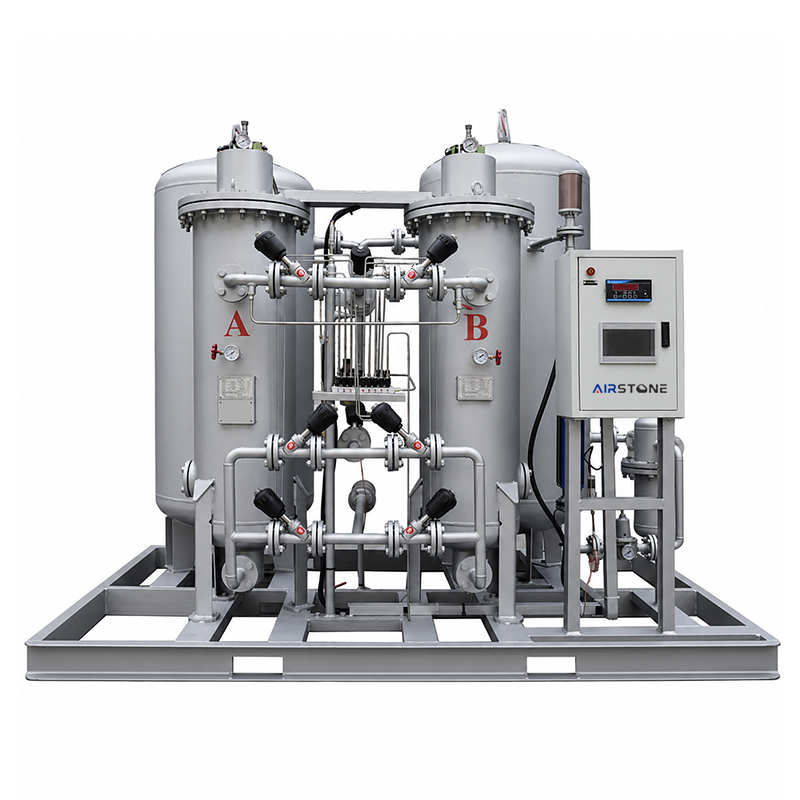
Process Flow
The adsorbent is the core component of nitrogen generation equipment.
The commonly used adsorbent is carbon molecular sieve, whose main component is elemental carbon. It appears as a black columnar solid (1-2 mm in diameter, 2-5 mm in height). Because it contains a large number of micropores (4 angstroms in diameter) with a strong instantaneous affinity for oxygen molecules, it is often used to separate oxygen and nitrogen from the air, which is then used to produce nitrogen via a pressure swing adsorption (PSA) device.
Carbon molecular sieve adsorption process: Carbon molecular sieves separate nitrogen and oxygen based on the slight difference in the kinetic diameters of O2 and N2. Oxygen molecules have a smaller kinetic diameter, resulting in a faster diffusion rate within the micropores of the carbon molecular sieve; nitrogen molecules have a larger kinetic diameter, resulting in a slower diffusion rate. Ultimately, high-purity nitrogen gas is enriched from the adsorption tower.

 8615015299001

 sales@airstone.net
  dgqianwei
 fg.cherry