


Summary of common causes of air compressor malfunctions during high summer temperatures
Air compressors frequently malfunction due to high temperatures in summer; here‘s a summary of the various causes!
1. The air compressor system is short of oil.
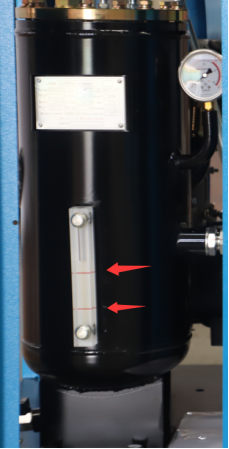
Check the oil level in the oil-air separator. After the machine is stopped and pressure is released, the lubricating oil level should be between the two red lines when the oil is at rest. During equipment operation, the oil level should not be lower than the low oil level mark. If insufficient oil is found or the oil level cannot be observed, stop the machine immediately and add oil.
2. Malfunctioning oil shut-off valve (oil cut-off valve).
The oil shut-off valve is typically a two-position, normally closed solenoid valve. It opens during startup and closes during shutdown to prevent oil from the oil-gas separator from continuing to spray into the compressor head and out of the air inlet when the compressor stops. If this component does not open during loading, the compressor will rapidly overheat due to lack of oil, potentially causing the screw assembly to burn out.
3. Oil filter problem.
A: clogged oil filter and a blocked bypass valve will prevent compressor oil from reaching the compressor head, causing the compressor to overheat rapidly due to lack of oil.
B: A clogged oil filter reduces flow. One possibility is that the compressor does not completely remove heat, causing the compressor temperature to rise slowly and become high. Another possibility is that the compressor overheats after unloading. This is because the internal oil pressure is high during loading, allowing oil to pass through, but after unloading, the low oil pressure makes it difficult for oil to pass through the oil filter, resulting in insufficient flow and overheating.
4. Malfunction of the thermal control valve (temperature control valve).
The thermal control valve is installed in front of the oil cooler. Its function is to maintain the exhaust temperature of the compressor head above the pressure dew point.
Its working principle is as follows: At startup, due to the low oil temperature, the thermal control valve branch is open, and the main circuit is closed, allowing lubricating oil to be sprayed directly into the compressor head without passing through the cooler. As the temperature rises above 40°C, the thermal control valve gradually closes, and oil flows through both the cooler and the branch circuit. When the temperature rises above 80°C, the valve closes completely, and all lubricating oil then passes through the cooler before entering the compressor head, maximizing lubricating oil cooling.
If the thermal control valve malfunctions, lubricating oil may enter the compressor head directly without passing through the cooler, preventing the oil temperature from dropping and causing overheating.
The main reasons for its malfunction are: firstly, the elastic coefficient of the two thermally sensitive springs on the valve core changes due to fatigue, preventing them from functioning properly with temperature changes; secondly, valve body wear, causing the valve core to jam or fail to close properly. Repair or replacement may be necessary depending on the situation.
5. The engine oil has exceeded its service life and deteriorated.
The oil‘s fluidity decreases, and its heat exchange performance declines. This results in the compressor head not being able to completely dissipate heat, causing the compressor to overheat.
6. Check if the oil cooler is working properly.
For water-cooled models, check the temperature difference between the inlet and outlet water pipes. Normally, this should be 5-8℃. A temperature below 5℃ may indicate scaling or blockage, which will affect the cooler‘s heat exchange efficiency and cause poor heat dissipation. In this case, the heat exchanger can be removed and cleaned.
7. Issues with the exhaust duct installed by customers of air-cooled models.
These include: exhaust ducts with insufficient airflow area, excessively long ducts, too many bends in the duct, and many long ducts without exhaust fans installed at bends, or exhaust fans with lower flow rates than the original cooling fan supplied with the air compressor.
8. Inaccurate temperature sensor readings.
If the temperature sensor is completely disconnected, the equipment will alarm and shut down, displaying a sensor malfunction message. If the malfunction is intermittent, it is more difficult to troubleshoot and can be resolved using a substitution method.
9. Compressor head issues.
Generally, the compressor head bearings should be replaced every 20,000-24,000 hours. The compressor‘s clearance and balance are determined by the bearings. Increased bearing wear will cause direct friction in the compressor head, increasing heat and potentially leading to overheating. In severe cases, the compressor may seize up and become unusable.
10. Incorrect or poor-quality lubricating oil.
The lubricating oil for screw compressors generally has strict requirements and cannot be arbitrarily substituted. The requirements in the equipment‘s instruction manual should be followed.
11. Clogged Air Filter.
A clogged air filter will cause the air compressor to be overloaded and remain under load for extended periods, leading to high temperatures. Check or replace the filter based on the alarm signal from the differential pressure switch. Generally, the primary problem caused by a clogged air filter is reduced air output; high air compressor temperature is a secondary symptom.
12. Excessive System Pressure.
System pressure is usually set at the factory. If adjustment is necessary, the rated air output pressure indicated on the equipment nameplate should be used as the upper limit. If adjusted too high, the increased machine load will inevitably lead to overheating and overcurrent overload phenomena. Similar to the previous reason, high air compressor temperature is a secondary symptom; the main manifestation of this reason is increased air compressor motor current, causing the air compressor to shut down under protection.
13. Clogged Oil-Gas Separator.
A clogged oil-gas separator will cause excessive internal pressure. Excessive pressure can cause many problems, including high temperature. This is similar to the previous two reasons; blockage in the oil-gas separator mainly manifests as high internal pressure.

 8615015299001

 sales@airstone.net
  dgqianwei
 fg.cherry